
Timed event classes may also be referred to as “games,” “gymkhanas,” or “O-Mok-See.” Generally the fastest time wins and deviating from the described rules or pattern will result in either a time penalty or disqualification, depending on the rule infraction.
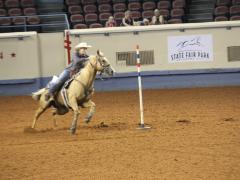
Judging
Before judging a timed event class, the judge should be familiar with each association’s rules and regulations as they may differ from one another. Since these classes are time, a judge’s primary responsibilities are to:
- Supervise the class to make sure rules are followed.
- Make sure the course is set up as prescribed by the appropriate rulebook.
Classes
There are a variety of timed classes, but arguably the most popular classes are:
- Barrel racing
- Pole bending
- Stake race
Barrel Racing
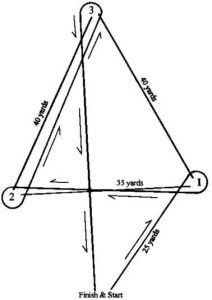
Barrel racing is by far the most popular timed event class. In barrel racing, riders must turn the barrels that are set in a cloverleaf pattern. This pattern is designed to test the speed and maneuverability of the horse. The exhibitor can turn the first barrel to either the right or the left. The first video below includes a rider turning the right barrel first and the second includes a rider turning the left barrel first.
- If the course is too large for the available space, the pattern should be reduced by an increment of 5 yards until the pattern fits the arena. The distance from barrel No. 3 need not be reduced 5 yards at a time if there is sufficient room for the horse to stop. Each barrel should be set at least 15 feet from the arena wall or fence.
Pole Bending
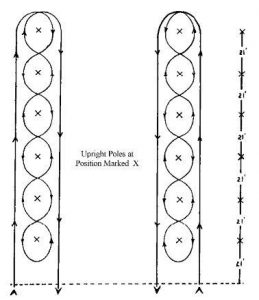
In this class, six poles are set 21 feet apart in the center of the arena. The pole that is closest to the time line, should also be set 21 feet from the time line. Riders complete the course by running to the far pole, weaving down the poles and back again before running home. Similar to the barrel racing event, riders can start on either the right or left side of the poles, working the pattern from either direction.
Stake Race
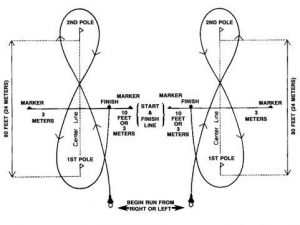
The stake race can be set up several different ways. Many open shows will set up a single pole at the far end of the arena, and riders simply run as fast as they can down the arena, turn the pole, and run back across the finish line. However, many breed shows will use two poles and have contestants run a figure 8.

Resources