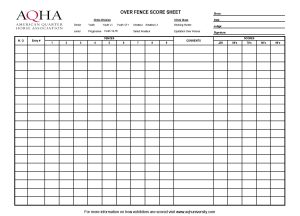
Equitation over Fences is judged primarily on how riders are positioned on the horse and how effective they are in using their aids while communicating with their mount when completing a course.

Course Requirements
The course may prove to be more challenging than a typical working hunter course by the addition of sharp turns or even by asking the rider to break to a trot in between fences.
Some organizations or associations will even test the riders by calling out a course after they have completed the known course and by including an on-the-rail proportion to further evaluate the rider’s abilities and skills.
Course Specifications
- Posted one hour prior to the class.
- At least one change of direction is required.
- Minimum height of fences must be 2’6” with maximum height of 3′ except for Level 1 (Novice).
- A minimum of four obstacles is required and horses must jump a minimum of six fences.
Scoring
- 90-100: Excellent equitation, position, and presentation; meets all fences squarely and at proper distance; uses all options to their advantage.
- 80-89: Minor equitation faults, i.e., long, weak distance, deep distance, one step landing at counter-canter. Rider still maintains a quality ride, smooth.
- 70-79: More problems occur; equitation suffers, i.e., rounded shoulders, heels are not down, hands incorrect, lacks style and presence. One major fence problem, i.e., chip with a ride up the neck, or discrete swap-out; jumping off one side of the jump. No dangerous fences; not a flowing course, out of rhythm riding (minor miss/”chip”), additional minor faults.
- 60-69: Major equitation faults, poor body position, loose legs and seat, failure to obtain or maintain trot to a trot fence approach, two or three misses at the fence. Cross canter or no change (60), extra stride in a measure line (61-64), multiple distance mistakes.
- 50-59 – Refer to the major faults listed below
- 40-49: Disobedience
- 10-39: Rider avoids elimination; two disobediences, knockdowns; dangerous fences, accumulative major faults.
Minor Faults
Suggested 2-5 point deduction per occurrence
- A jump out of rhythm (minor miss/”chip”)
- Obvious pace changes
- One step of cross canter (1 point for each stride up to 4 strides, additional cross canter strides major fault)
- Swap lead in front of jump
- Rail (4 point deduction per rail)
- Wrong diagonal up to 2 steps
- Hands not at a 45 degree angle
- Ahead or behind motion at jump
- Canter trot jump one stride or less
Major Faults
Suggested 10-20 point deduction per occurrence
- Canter the trot jump more than 2 strides
- No lead change (60)
- Kicking out (50)
- Dangerous jumping/excessive speed
- Wrong lead once competition round has begun (10 point deducation)
- Using stick on horse in ring (50)
- Manners
- Major out of rhythm (major miss/”chip”)
- Loss of stirrup (50)
- Loss of reins (50)
- First disobedience (40)
- Second disobedience (30)
- Wrong diagonal over 2 steps
- Holding reins incorrectly
Elimination
- Falling off
- Three disobediences
- Off course
- Failure to trot soundness circle
- Bolting from ring
Resources
- AQHA Handbook
- APHA Handbook
- Basic Fence Positions Video
- Example Scoresheet