
Conformation is defined as the correctness of bone, musculature, and proportions. It is often referred to as “form to function” as a horse’s conformation directly relates to the horse’s ability to perform specific tasks.
Judging
- Overall evaluation: Each horse should be individually examined for conformational defects, soundness, and way of travel at the walk and jog/trot as it is led directly to and away from the judge and at the jog from a direct side angle. The horse must move straight and true. This is essential regardless of the competition the horse will ultimately perform.
- Gaits:
- The walk should be a natural flat-footed, four-beat gait. The walk must be alert, with a stride of reasonable length for the size of the horse.
- The jog/trot should be a smooth, ground-covering, two-beat diagonal gait. The jog/trot should be square, balanced with straightforward movement of the feet.
- Obvious lameness is cause for disqualification. Obvious lameness is:
- Consistently observable at a trot under all circumstances
- Marked nodding, hitching, or shortened stride
- Minimal weight-bearing in motion and/or at rest
Evaluation
While many characteristics of good conformation are the same across all breeds, other characteristics that are desirable in one breed may not be desirable in another. However, the ideal standard in evaluating horses in halter classes should include a positive combination of these criteria:
- Balance
- Structure (i.e., soundness and correctness of conformation)
- Muscling
- Breed and sex characteristics
- Quality and refinement
- Correct manner of travel or way of going
1) Balance
To most people, balance is the most important category as it indicates how proportional a horse is. In most cases, the more correctly balanced a horse is, the more athletic it will be, no matter its purpose or discipline. Balance can often be described as how well a horse’s parts fit together. To evaluate balance:
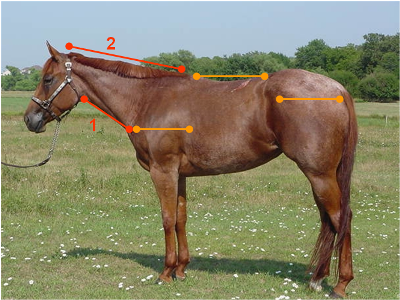
- When viewed from the side, the length of the shoulder, back, and hip should all be equal. This is known as the rule of thirds. Figure 1 demonstrates this conformation.
|
Figure 1. |
|
|

- The horse’s neck should be equal to or longer than the shoulder, back, and hip.
- The top of the neck should ideally be twice as long as the underside of the horse’s neck, or a 2-to-1 ratio. This is demonstrated by the red lines in Figure 2.
| Figure 2. |
|
|
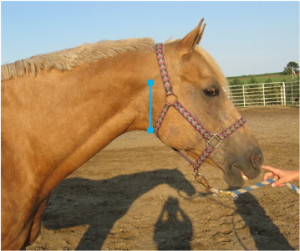
- A horse’s face should be equal to or shorter than the length of the horse’s back, hip, and shoulder. This is demonstrated by the blue line in Figure 3.
| Figure 3. |
|
|

- Ideally, the back of the horse should be shorter than its underline. See the white lines in Figure 4.
| Figure 4. |
|
|

- The heart girth should equal to the length from the underline to the ground. See Figure 5.
| Figure 5. |
|
|

Learn more about evaluating balance by watching the videos below.
2) Structure
Structure involves evaluating the horse’s skeleton, or bone structure, which can predict how the horse will move. Like muscling, structure should be evaluated from the front, profile, and rear. One of the best places to start the evaluation of structure is to look at the angle of the shoulder.
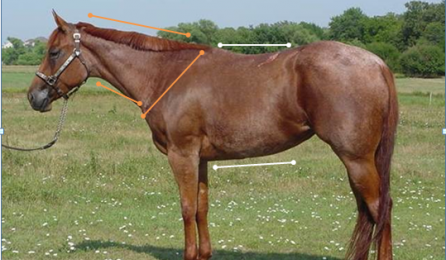
- Angle of the shoulder: The angle of the horse’s shoulder should be approximately 45°. A shoulder angle of less than 45° results in a shorter stride as well as a longer back. Often, this is accompanied by a less desirable neck. This is illustrated in Figure 6 below in which the horse on the right exhibits a more desirable slope of shoulder.
| Figure 6. The horse to the left is steeper in the slope of its shoulder, whereas the horse on the right exhibits more desirable slope of shoulder. | |
 |
 |
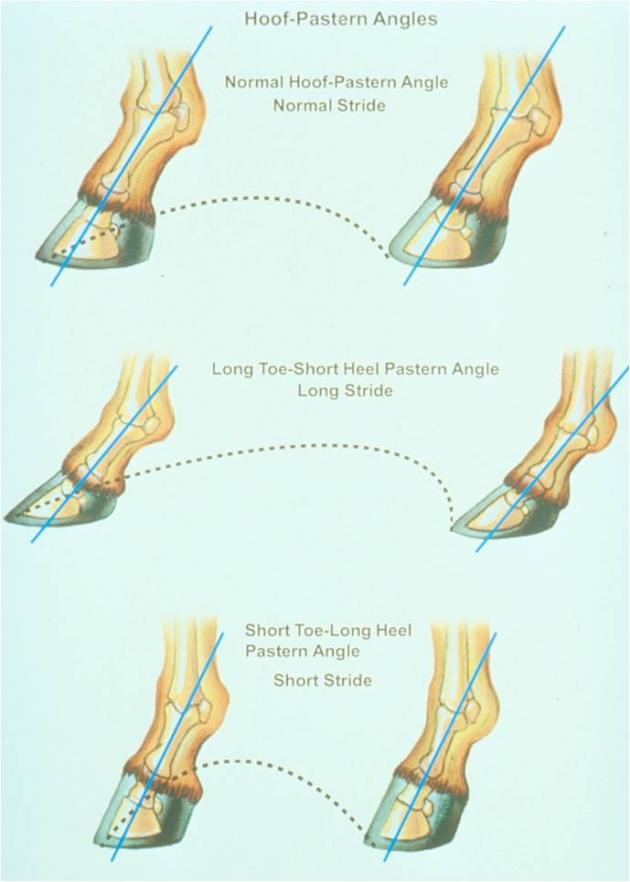
- Hoof angles are crucial to the soundness and stride of a horse.
-
- A long toe, short heel will create a long stride.
- A short toe, long heel will create a short stride.
| Figure 7. Hoof Angles
Illustrated Atlas of Clinical Equine Anatomy and Common Disorders of the Horse, Volume 1. Riegel, 1996. |
 |
- Hip shape: When viewed from the side, the hip of the horse should appear square. See Figure 8 for the square box that depicts the hips.
| Figure 8 |
|
|

Further criteria to look for in correct structure include these areas:
- Clean throat latch
- Correct head and neck size
- Hoof and pastern (45°)
- Withers
- Back
- Legs
- Strong top line
- Correct hock placement
| Figure 9. This horse is very thick and coarse in its throat latch, which is undesirable. |
|
|
Evaluating Structure Practice
Use Figure 10a and 10b to practice evaluating structure.
| Figure 10a. | Figure 10b. |
 |
|

Note a few of the differences between these two horses:
- The horse in Figure 10a is not as accurate in its 2:1 neck ratio compared to the sorrel in Figure 10b.
- The chestnut horse in Figure 10a is cleaner in its throat latch and ties in higher in its neck to the chest attachment compared to the horse in Figure 10b.
- The sorrel in Figure 10b has a shorter and stronger back than the chestnut horse in Figure 10a.
For further information on evaluating structure, watch the following video.
3) Muscling
When evaluating muscling, consider both muscle volume and muscular definition. Muscle volume is the overall amount of muscle, with definition or delineation referring to the separation of the different muscles, often referred to as “chiseling.” To better understand these concepts, consider a “strong man”: he likely has a great deal of muscle volume. By contrast, a gymnast may have less volume but greater definition to his or her muscle pattern.
To evaluate muscling:
- View muscling from the front, the side or profile, and the rear.
- When evaluating from the front, focus on the chest or pectorals (the “V” that the front legs create) and the forearm. These can be seen in Figure 11.
| Figure 11. |
|
|

- When evaluating muscle from the profile view, focus on the shoulder and forearm, loin, and hindquarter including the stifle.
- When evaluating from the rear, make sure that the horse is wider through the stifle than at the point of the hip. Further, observe the inner and outer gaskin.
- In Figure 12, the red lines depict the ratio of stifle and the point of the hip, while the blue line shows the gaskin.
| Figure 12. |
|
|

Muscling is important to evaluate in all breeds and types of horses, and more relative muscling is always desirable, including in the Fine and Society breeds.
To learn more about evaluating muscling, watch the video below.
4) Quality and Refinement
Evaluating quality and refinement involves looking at the following:
- Overall general appearance
- Appealing head and neck
- Quality of bone/muscle
These terms refer to the overall appearance of the horse. We specifically look at things like thickness of hair coat, texture of the skin, and tightness of the skin especially in areas of the face, joints, and lower legs.
5) Breed and Sex Characteristics
Each breed has its own proper characteristics. For example, stock horses are different from Arabians. Female/male characteristics are noticeable in the correct sex of the horse. Following are some characteristics of specific breeds such as draft horses, fine or society breeds, and stock horses.
Hunter Conformation
Draft Horses
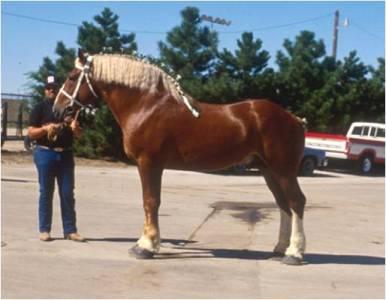
Draft horses were initially bred for work. They are typically taller, heavier boned, and have a rounder type of muscle pattern than light horse breeds. These horses are also known as cold-bloods, and the criteria for quality are largely why. Draft horses will have the thickest skin and haircoat and may have more fleshiness in the face than lighter breeds of horses. However, within a draft horse class, horses that exhibit more quality and refinement are preferred. Figure 13 shows an example of a Belgian draft horse.
| Figure 13. |
|
|
Arabian Horses
The Arabian breed is on the other end of the spectrum for quality and refinement. These horses have a very thin haircoat, and you can often see the skin right through the hair, especially around the eyes and muzzle. There is no excess hair on the lower legs, and the tendons should be clearly defined. Fleshiness in the face and in the lower legs should be penalized.
Fine or Society Breeds
Fine or society breeds such as the Arabian, Saddlebred, and Morgan were developed as riding horses and are narrower framed, lighter boned, and lighter muscled than draft horse breeds. These breeds are known for their brilliant movement and their high tail carriage.
See the following lecture on Saddlebred/Morgan conformation.
Saddle Type in Hand – Arabian
Stock Breeds
Stock breeds, such as the Quarter Horse, Appaloosa, and Paint, tend to be wider framed and more heavily muscled. Figure 14 shows an example of a Quarter Horse.
| Figure 14. |
 |
6) Travel or Way of Going
Evaluating a horse’s quality of movement includes the length of stride, whether the horse travels in a straight line, picks up its feet or tracks up with the hind legs. Way of going should be evaluated from the side, front, and rear. At shows, quality of movement is evaluated at the walk and trot. This is also a time to evaluate the horse for soundness.
- From the side, look for a horse that moves with a long stride and has equal use of the front and hind legs. For some breeds, judges want to see a lot of flexion in the knees and hocks (Saddlebreds, Morgans, Arabians, and most other breeds shown saddleseat). In other breeds, judges look for a flatter knee and hock (hunters and most stock breeds).
- From the front and rear, look for horses that travel straight, with no deviation from side to side and with the legs staying parallel.
To learn more about evaluating way of going, watch the video below.
Resources