
The western riding class is one of flying lead changes. It is a combination of control and skills, mixing techniques from trail, reining, and equitation. This is a judged event and is not timed.
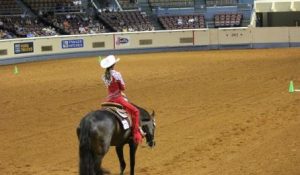
The horse is judged on these criteria:
- Quality of gaits
- Lead changes at the lope
- Response to the rider
- Manners and disposition
Lead Changes
- Must be done in a collected and controlled manner.
- Change precisely and simultaneously front/hind at the center point between markers.
- Lead change locations must be consistent in their location and centered in between each cone.
- View the Penalties section for more information on lead change locations.
Patterns
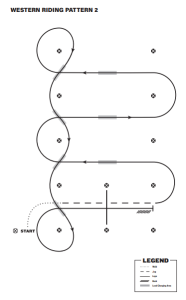
Different associations provide multiple patterns. Pattern II of AQHA is displayed below.
Scoring
Before scoring a western riding, the judge should be familiar with each association’s rules and regulations as they may differ from one another. The scoring system for this class ranges from 0 to 100, with 70 being an average performance.
Maneuver Score
Each maneuver indicated in the pattern receives a maneuver score of +1 1/2 to -1 1/2 with half point increments and 0 indicating an average maneuver. The following are the general guidelines used to determine appropriate maneuver scores:
+1 1/2 Excellent
+1 Very Good
+1/2 Good
0 Average
-1/2 Poor
-1 Very Poor
-1 1/2 Extremely Poor
Penalties
- Common penalty points are ½, 1, 3, and 5
- Maneuvers are scored independently of penalty points.
- A diagram for lead change penalties is included below.
- Exhibitors may also received a 0 score or disqualification. These are generally reserved for instances such as breaking the pattern, breaking the rules or abuse of the animal.
- Judges and exhibitors should refer to the desired association specific guidelines, rules, patterns, and score sheets for the most accurate information.

Credits
- Being collected/controlled
- Accuracy and smoothness
- Steadiness
- Even cadence/pace throughout the class
- Response to rider
- Manners and disposition
- Relaxed head carriage
- Light contact or reasonably loose reins
Faults
- Uncollected/uncontrolled
- Excessive open mouth
- Anticipating signals/changes
- Stumbling
Resources
- AQHA Rulebook
- APHA Rulebook
- Judging Western Riding Video
- Simple Lead Change video
- Flying Lead Change video
- AQHA and APHA Scoresheets