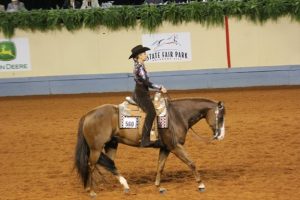
The western horsemanship event is judged both on how the horse performs for the rider and the rider’s skill. Judges evaluate the rider’s position and tests the ability of the rider and the horse to perform a prescribed pattern.
Rider’s Position
- The rider should sit in the center of the saddle, forming a straight line from the ear, through the center of the shoulder and hip, touching the back of the heel or through the ankle.
- The reins should be adjusted so that the rider has light contact with the horse’s mouth.
- At no time should the reins require more than a slight hand movement to control the horse.
- Excessively tight or loose reins will be penalized.
Procedures
- The class must work at all three gaits at least one direction of the arena.
- The ideal horsemanship pattern is extremely precise with the rider and the horse working in complete unison, executing each maneuver with subtle aids and cues. The following maneuvers are acceptable in a pattern:
- Walk, jog, extended jog, lope or extended lope in a straight line, curved line, serpentine, circle, or figure eight, stop, back in a straight or curved line, turn or pivot, including spins and rollbacks on the haunches and/or on the forehand, side pass, two-track, flying or simple lead change, counter canter, or ride without stirrups
- A back should be asked for at some time during the class.
Scoring
Before scoring a horsemanship class, a judge should be familiar with each association’s rules and regulations as they may differ from one another. Most associations use a scoring system where scores range from 0 to infinity, with 70 being an average score.
Maneuver Score
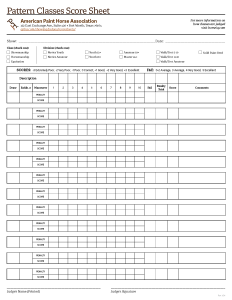
Each maneuver indicated in the pattern receives a maneuver score of +3 to -3 with half point increments and 0 indicating an average maneuver. The following are the general guidelines used to determine appropriate maneuver scores:
+3 Excellent
+2 Very Good
+1 Good
0 Correct
-1 Poor
-2 Very Poor
-3 Extremely Poor
Form and Effectiveness Score (F&E)
Each exhibitor receives a form and effectiveness (F&E) score to evaluate their overall horsemanship. F&E scores range from 0-5. The following are general guidelines used to determine appropriate F&E scores:
5 Excellent
4 Very Good
3 Good
0-2 Average

Penalties
- Common penalty points are 3, 5 and 10
- Exhibitors may also receive a 0 score or no score. These are generally reserved for instances such as breaking pattern, breaking rules or abuse of the animal
- Judges and exhibitors should refer to the desired association specific guidelines, rules, patterns and score sheets for the most accurate information
Pattern Score Sheets