
Several competitive events involve horses jumping over an obstacle or a series of obstacles. Although they all involve jumping, there are specific differences among the disciplines. These classes are also offered either at breed shows (American Quarter Horse Association (AQHA), American Paint Horse Association (APHA), etc.) or at discipline-based shows (United States Equestrian Federation (USEF), United States Eventing Association (USEA), United States Hunter Jumper Association (USHJA)).
- Show Jumping — Horse and rider are scored only on time and successful clearing of all fences.
- Hunter over Fences — Horses and rider are judged on form over fences, rhythm between fences, jumping ability, and other criteria.
- Hunter Equitation over Fences — Riders are scored on their ability to ride a horse around a course in the hunter style.
- Cross Country — Horses and riders complete a course over natural terrain through fields and wooded areas jumping stationary fixed obstacles. Scoring is based on negotiating all the fences and time.
- Combined Test — Horses are scored in dressage and show jumping, with a combined score determining final placings.
- Horse Trial/Eventing/Three-Day Event — Horses complete dressage, show jumping, and cross country. They may complete these all in one day or over three days.
Show Jumping

Show jumping involves three primary types of obstacles, depending on the level of competition. The jumps are brightly colored and may include a wide variety of creative designs, everything from butterflies and killer whales to plain poles and gates. Jump courses are made up of a combination of jump types, with the most common being crossrails, verticals, oxers, and water jumps.

Crossrails are an introductory jump and are primarily used in training and at lower levels of competition. Poles are set with one end in the cup and the other end on the ground. The rails can be moved up, but one end always remains on the ground for crossrails.
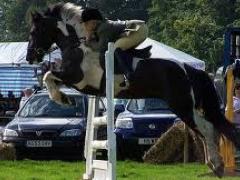
The most common type of jump in competition is a vertical. Vertical jumps have only height and no width. The picture below shows a typical vertical made from jump poles. However, verticals can also include gates, walls, and other obstacles, as long as these do not add any width to the jump.
An oxer is basically two verticals (three verticals are called a “triple bar”) that are put together to make a single jumping effort. Oxers increase in difficulty by increasing height, width, or both. The oxer can be either of these types:
- An ascending oxer in when the front vertical is slightly lower than the rear jump, which assists the horse in assessing the width of the jump
- A square oxer includes both verticals are at the same height
- A Swedish oxer is when the verticals appear to be an “X” where the right side of one vertical and the left side of the other vertical are higher than the opposite side

Water jumps include both a height and a width component. If the horse touches any part of the water, it counts as a fault which is equivalent to knocking down a rail on another kind of jump.

Scoring
The horses are timed from a start and finish line, and a final score is obtained by combining the number of jumping faults, number of disobedience faults, and time faults.
If multiple horses have the same score, then the horse with the faster time will be placed above the other horse. If more than one horse achieves a “double clear,” meaning they received no jumping or time faults. The horses will participate in a “jump off” where they will jump a second course. This course goes in the same direction, but usually consists of fewer, but higher jumps. The horse with the lowest number of points wins the jump off. However, if there is more than one clean round, the fast time will win.
A few more details about scoring show jumping:
- Time allowed will be determined by the show management, judges, and professional course designer.
- Time to complete the course should be double the time allowed.
Faults
- Knockdowns (4 faults)
- First Disobediences (4 faults)
- Refusal
- Run-out
- Loss of forward movement
- Unnecessary circling on course
- Time faults for going over time
Disqualification
- Jumping an obstacle before reset
- Starting before judges signal to proceed
- Failure to enter the ring within 1 minute
- Failure to cross the start line within 45 seconds after signaled to begin
- Off course
- Deliberately addressing an obstacle
- Excessive use of whip, crop, bat, reins, etc.
Resources