
Hunt Seat Equitation evaluates the ability of the hunter rider to perform various maneuvers on his or her horse which provides a base for the natural progression to over-fence classes. The hunt seat equitation class:
- Tests an amateur or youth’s ability to ride, not solely the performance of the horse.
- Contestants may work a predetermined pattern and/or perform rail work.
- Emphasizes the ability to sit correctly, hold the correct riding posture, and control the horse precisely with subtle cues.
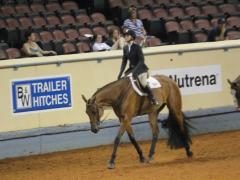
Rider Position
- The rider’s hands should be over and in front of the horse’s withers with their knuckles 30 degrees inside the vertical. Hands should be slightly apart and form a straight line from the horse’s mouth to the rider’s elbow.
- The rider should keep their eyes up and their shoulders back.
- Toes can be angled in a way that best suits the rider’s conformation, with heels down and their calf in contact with the horse.
- Iron should be on the ball of the foot.
Procedures
- Judging is based on the rider and his/her effect on the horse and pattern performance.
- All patterns must include exhibitors to perform at the walk, trot, canter, and back.
- The entire class or just the finalists must work all three gaits on the rail at least one direction.
Patterns
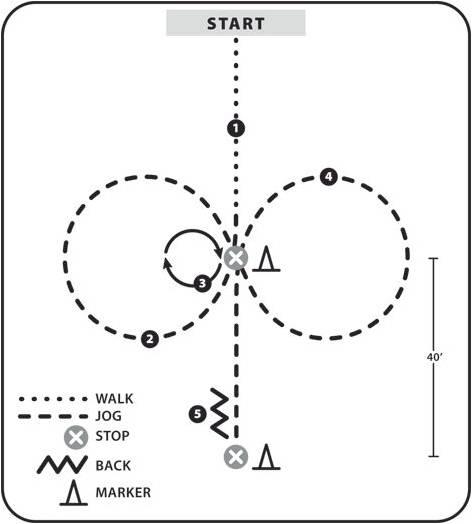
Patterns may consist of maneuvers such as:
- Changing gaits
- Travel in a figure-8 pattern
- Posting on correct diagonal
- Changing leads
- Counter-cantering
- Turn on the haunches or forehand
- Leg-yield
Sample Pattern
Description of Gaits
Posting Trot
At the posting trot, riders are required to post on the correct diagonal. On the left diagonal, the rider should sit in the saddle when the left front leg is on the ground and the sit in the saddle when the right front leg is on the ground for the right diagonal. A good saying to help remember diagonals is, “Rider should rise and fall (post) with the leg on the wall,”
Two-Point Position
Hand Gallop
The hand gallop is a three-beat, lengthened canter ridden in the two-point position.
Scoring
Before scoring a equitation class, a judge should be familiar with each association’s rules and regulations as they may differ from one another. Most associations use a scoring system where scores range from 0 to infinity, with 70 being an average score.
Maneuver Score
Each maneuver indicated in the pattern receives a maneuver score of +3 to -3 with half point increments and 0 indicating an average maneuver. The following are the general guidelines used to determine appropriate maneuver scores:
+3 Excellent
+2 Very Good
+1 Good
0 Correct/Average
-1 Poor
-2 Very Poor
-3 Extremely Poor
Form and Effectiveness Score (F&E)
Each exhibitor receives a form and effectiveness (F&E) score to evaluate their overall horsemanship. F&E scores range from 0-5. The following are general guidelines used to determine appropriate F&E scores:
5 Excellent
4 Very Good
3 Good
0-2 Average
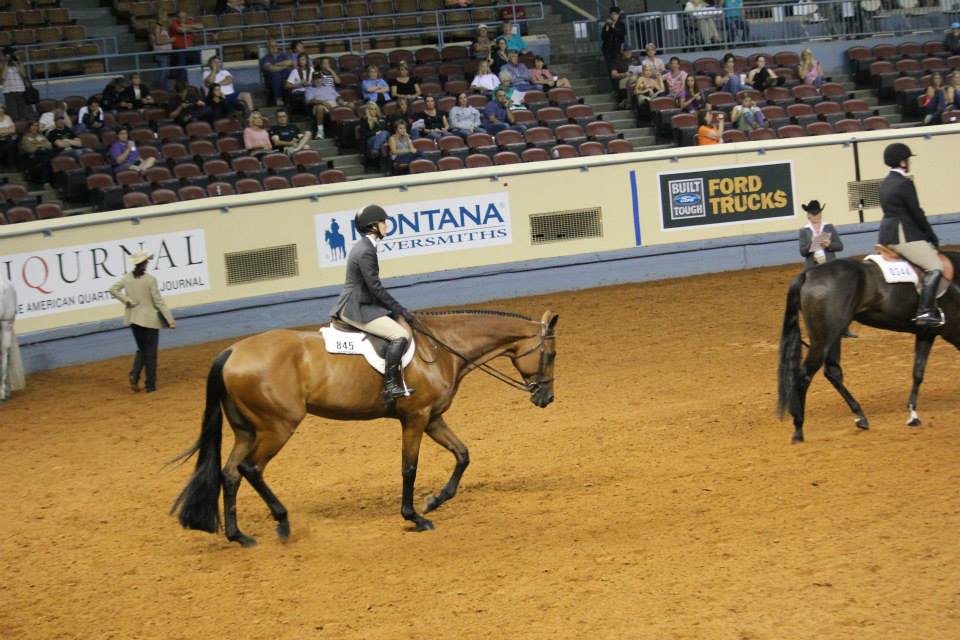
Penalties
- Common penalty points are 3, 5, and 10
- Exhibitors may also receive a 0 score or no score. These are generally reserved for instances such as breaking the pattern, breaking the rules, or abuse of the animal.
- Judges and exhibitors should refer to the desired association specific guidelines, rules, patterns, and score sheets for the most accurate information.
Examples of Equitation Runs
Hunt Seat Equitation
Saddle Seat Equitation
Resources
- AQHA Rulebook
- APHA Rulebook
- Judging Equitation
- Pattern Score Sheet