While cattle events at a rodeo or jackpot event are based on time. Cattle classes at a breed association shows are judged based on the performance of the horse.
Roping Events
The purpose of a roping class is to provide an opportunity for the horse to demonstrate and be judged on its natural talent and ability, its willingness to perform, and the level of training that makes it suitable for competitive timed roping events outside of the arena. The rope horse will be evaluated through a series of individually judged maneuvers that, when combined, result in a score that most accurately reflects its ability to allow its rider to catch and handle a calf or steer most efficiently and effectively.
Requirements
- The horse must start from the roping box.
- Tie-down roping and heading horses in the dally team roping must start behind a barrier.
- Only the horse’s performance is to be judged. This includes their manners behind the barrier and throughout the entire run.
- There is a one-minute time limit.
Tie-Down Roping
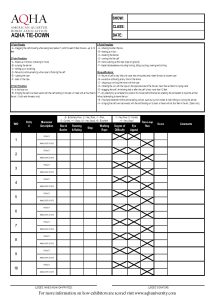
Tie Down Roping is a judged event at breed association shows where the roper while mounted throws his rope to catch the calf, dismounts their horse from either side, runs down the rope to flank the calf and then tie at least three legs together with a piggin string. The roper may throw two loops, but this must be done within the on minute time limit. Time starts when the calf leaves the chute and stops when the rider signals for time after tying the calf. Although the time has stopped, judging does not. Judging ends when the rider mounts the horse and rides the horse forward. Additional information about tie down roping is included below:
- If a roper fails to catch the calf with two loops, they receive a no score.
- Any catch is legal as long as the rope remains on the calf until the tie is complete and the roper has remounted their horse
- If the calf is not standing when the roper reaches the calf, the roper must re-throw the calf by hand
- To tie the calf, the roper must cross any three feet and tie these feet together with at least one complete wrap around all three feet and secure with a half hitch
- The rope must be run through a foul rope around the horse’s neck and may, at the discretion of the rider, be run through a “keeper.” If a keeper is used, it must be attached to the noseband of the tie-down but never in front of the head stall and cannot be attached to the bridle or bit
- Only the roper may touch the calf while the horse is being judged

Scoring
Before scoring a tie down roping class, the judge should be familiar with each association’s rules and regulations as they may differ from one another. The score system for this class ranges from 0 to 100, with 70 being an average performance.
Maneuver Scoring
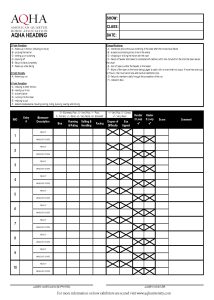
The tie-down roping horse will be judged on four different maneuvers:
- Box and barrier
- Running and rating
- Stop
- Working the rope
Each maneuver receives a maneuver score of +3 to -3 with half point increments and 0 indicating an average maneuver. The following are the general guidelines used to determine appropriate maneuver scores:
+3 Extremely Good
+2 Very Good
+1 Good
0 Average/Correct
-1 Poor
-2 Very Poor
-3 Extremely Poor
Penalties
- Common penalty points are 1, 2, 3, and 5
- Exhibitors may also receive a 0 score. These are generally reserved for instances failure of calf to remain tied, excessive schooling, and inhumane treatment of the animal.
- Judges and exhibitors should refer to the desired association specific guidelines, rules, and score sheets for the most accurate information for their association.
Faults
Faults are to be scored according to severity.
- Jerking the reins
- Slapping
- Jerking the rope
- Turning around in the box
- Turning the head severely
- Squatting in the corner
- Stopping crooked
- Rearing up in stop
- Ducking off
- Looking off while working the rope
- Shying away while the roper is remounting
Dally Team Roping
The heading horse and the heeling horse are to be entered and scored individually, not as a team.
Requirements
- All team roping cattle shall be protected by horn wraps.
- Legal catches are required by both the header and the heeler (see below for legal catches).
- The roper on the horse being judged may throw two loops.
- The header must head the steer, and the heeler must heel the steer. They are not allowed to switch roles.
- Riders are to stay mounted.
- Each contestant will select the other member of his or her team.
Legal Catches Defined
- Heading
- Legal catches in heading are both horns, half-head, and around the neck.
- Any figure-eight, front leg, or the tip of a horn is not a legal heading catch.
- Heeling
- Legal catches for heeling include a catch that holds from behind the steer’s shoulders and back, around the flank or on one or both heels.
-
A tail-only catch is not a legal heeling catch.

Heading
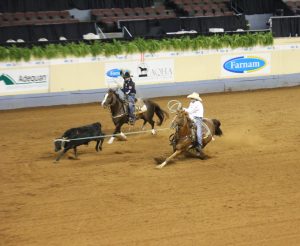
In a team roping class, both the header and heeler will begin in the roping box, with the header behind a barrier. The header will catch the steer with one of the three legal head catches and dally the rope around the saddle horn. After dallying the roper will turn the steer for the heeler to throw their rope. Once the heeler has caught and dallied, with a legal catch, the header will turn and face the steer.
Scoring
Before scoring a heading class, the judge should be familiar with each association’s rules and regulations as they may differ from one another. The score system for this class ranges from 0 to 100, with 70 being an average performance.
Maneuver Scoring
The heading horse will be judged on four different maneuvers:
- Box and barrier
- Running and rating
- Setting and handling
- Facing
Each maneuver receives a maneuver score of +3 to -3 with half point increments and 0 indicating an average maneuver. The following are the general guidelines used to determine appropriate maneuver scores:
+3 Extremely Good
+2 Very Good
+1 Good
0 Average/Correct
-1 Poor
-2 Very Poor
-3 Extremely Poor
Penalties
- Common penalty points are 2, 3, and 5
- Exhibitors may also receive a 0 score. These are generally reserved for failure to catch the steer, excessive schooling, and inhumane treatment of the animal.
- Judges and exhibitors should refer to the desired association specific guidelines, rules, and score sheets for the most accurate information for their association.
Faults
Faults are scored according to severity.
- Jerking the reins
- Slapping
- Jerking the rope
- Turning around in the box
- Turning head severely
- Squatting in the corner
- Incorrect position
- Failure to rate
- Failure to run the steer
- Horse being outrun by the steer
Heeling
In a team roping class, both the header and heeler will begin in the roping box. Once the header has caught and turned the steer, the heeler is able to throw this rope. If the heeler catches with a legal catch, the roper will also dally around the saddle horn and their horse will come to a stop, while the header turns to face the steer.
Scoring
Before scoring a heeling class, the judge should be familiar with each association’s rules and regulations as they may differ from one another. The score system for this class ranges from 0 to 100, with 70 being an average performance.
Maneuver Scoring
The heeling horse will be judged on four different maneuvers:
- Box
- Run and rate
- Position
- Stopping
Each maneuver receives a maneuver score of +3 to -3 with half point increments and 0 indicating an average maneuver. The following are the general guidelines used to determine appropriate maneuver scores:
+3 Extremely Good
+2 Very Good
+1 Good
0 Average/Correct
-1 Poor
-2 Very Poor
-3 Extremely Poor
Penalties
- Common penalty points are 2, 3, and 5
- Exhibitors may also receive a 0 score. These are generally reserved for failure to catch the steer, excessive schooling, and inhumane treatment of the animal.
- Judges and exhibitors should refer to the desired association specific guidelines, rules, and score sheets for the most accurate information for their association.
Faults
Faults are to be scored according to severity.
- Jerking the reins
- Slapping
- Jerking the rope
- Turning around in the box
- Turning head severely
- Squatting in the corner
- Incorrect position
- Failure to be in correct lead before the horse moves into position on the steer
Other Cattle Classes
Team Penning
- A team of three riders must sort three specifically identified head of cattle from a herd and then pen them at the other end of the arena. Time continues until all unpenned cattle are completely on the cattle side of the starting line, within a specified time limit. The fastest time wins.
Working Cow Horse
- Judging is based on a cow work portion and a reined work portion.
- Scoring emphasis should be based on the horse maintaining control of the cow at all times, exhibiting superior cow sense and natural cow working ability.
- Refer to your association’s rulebook and the National Reined Cow Horse Association website for more information.
Breakaway
- This is a timed event with a one-minute time limit, in which calves must be used.
- It is performed with the same general rules as calf roping. However, the end of the rope is tied to the saddle horn with a heavy string with a cloth or flag that is visible to the flagger. Once the roper has caught the calf, their horse will stop and the string will break away from the horn when the calf causes the rope to come tight.
- The horse must start from behind a barrier and a 10-second penalty will be added to the time for breaking the barrier.
Boxing
- Judging is based on a boxing portion and a reined work portion.
- The aim is to familiarize the rider with the boxing portion of the cow work.
- The contestant has 50 seconds to showcase the horse’s ability to hold a cow at the end of the arena.
- Refer to your association’s rulebook and the National Reined Cow Horse Association website for more information.
Cutting
- The cutting class is a battle of wills between a horse and cow. The horse and rider must move quietly into a herd of cattle, cut one animal from the herd, drive it to the center of the arena, and hold it away from the herd. The cutting horse must match moves with the cow, anticipating its every maneuver.
- Score is based on these criteria:
- Horse’s ability to keep the cow away from the herd
- Cow sense
- Attentiveness
- Courage.
- Refer to your association’s rulebook and the National Cutting Horse Association website for more information.
Resources
- AQHA Rulebook
- APHA Rulebook
- AQHA and APHA Scoresheets